Phase 3: Feature prioritization & stakeholder alignment
Balancing Ambition with Reality
Balancing Ambition with Reality
Balancing Ambition with Reality
Balancing Ambition with Reality
The goal: To translate validated user needs into a realistic development roadmap by balancing user value, technical constraints, and business growth.
The goal: To translate validated user needs into a realistic development roadmap by balancing user value, technical constraints, and business growth.
What to build first and why
What to build first and why
Research Methodology
Research Methodology
Workshop instead of working in a vacuum, I led a strategic workshop with stakeholders and the development team to ensure shared ownership of the product direction.
Workshop instead of working in a vacuum, I led a strategic workshop with stakeholders and the development team to ensure shared ownership of the product direction.
Ideation:
Ideation:
Generating features directly linked to the pain points identified in Phase 2.
Generating features directly linked to the pain points identified in Phase 2.
Affinity Mapping:
Affinity Mapping:
Clustering fragmented ideas into meaningful functional groups.
Clustering fragmented ideas into meaningful functional groups.
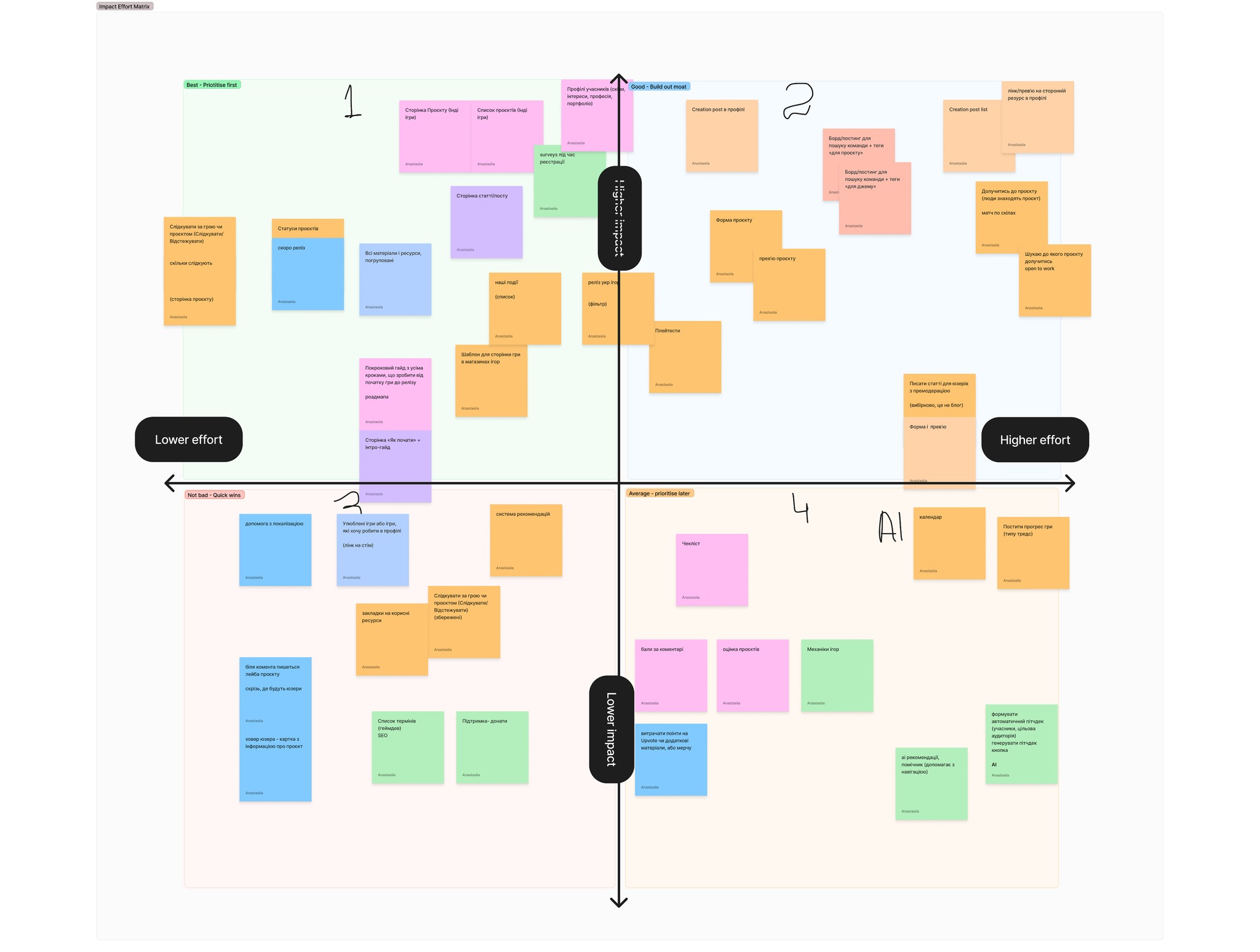
Impact-Effort Matrix:
Impact-Effort Matrix:
The core tool used to evaluate every feature’s potential impact against the required development effort.
The core tool used to evaluate every feature’s potential impact against the required development effort.
Defining the MVP Roadmap
Defining the MVP Roadmap
The conversation shifted from "what would be nice" to "what delivers value now." This allowed us to strip away non-essential complexity and avoid early-stage over-engineering.
The conversation shifted from "what would be nice" to "what delivers value now." This allowed us to strip away non-essential complexity and avoid early-stage over-engineering.
MVP 1 Focus: Essential features for validating the product core with real users (e.g., project visibility, core networking).
MVP 1 Focus: Essential features for validating the product core with real users (e.g., project visibility, core networking).
Post-MVP Strategy: High-value features deferred to later stages to manage technical risks and dependencies.
Post-MVP Strategy: High-value features deferred to later stages to manage technical risks and dependencies.
Key insight:
Key insight:
We exited the workshop with a lean, validated feature set and high team confidence. This strategic alignment ensured that every pixel designed in the next phase served a specific, prioritized purpose.
We exited the workshop with a lean, validated feature set and high team confidence. This strategic alignment ensured that every pixel designed in the next phase served a specific, prioritized purpose.
Why This Phase Mattered
Why This Phase Mattered
We left the workshop with:
We left the workshop with:
A shared understanding of the target audience,
A shared understanding of the target audience,
A clear MVP feature set,
A clear MVP feature set,
Confidence in the product direction.
Confidence in the product direction.